Device Handoffs: How Progression Systems Bridge Mobile and Desktop Worlds
Erik Lange · May 26, 2026
Device Handoffs: How Progression Systems Bridge Mobile and Desktop Worlds
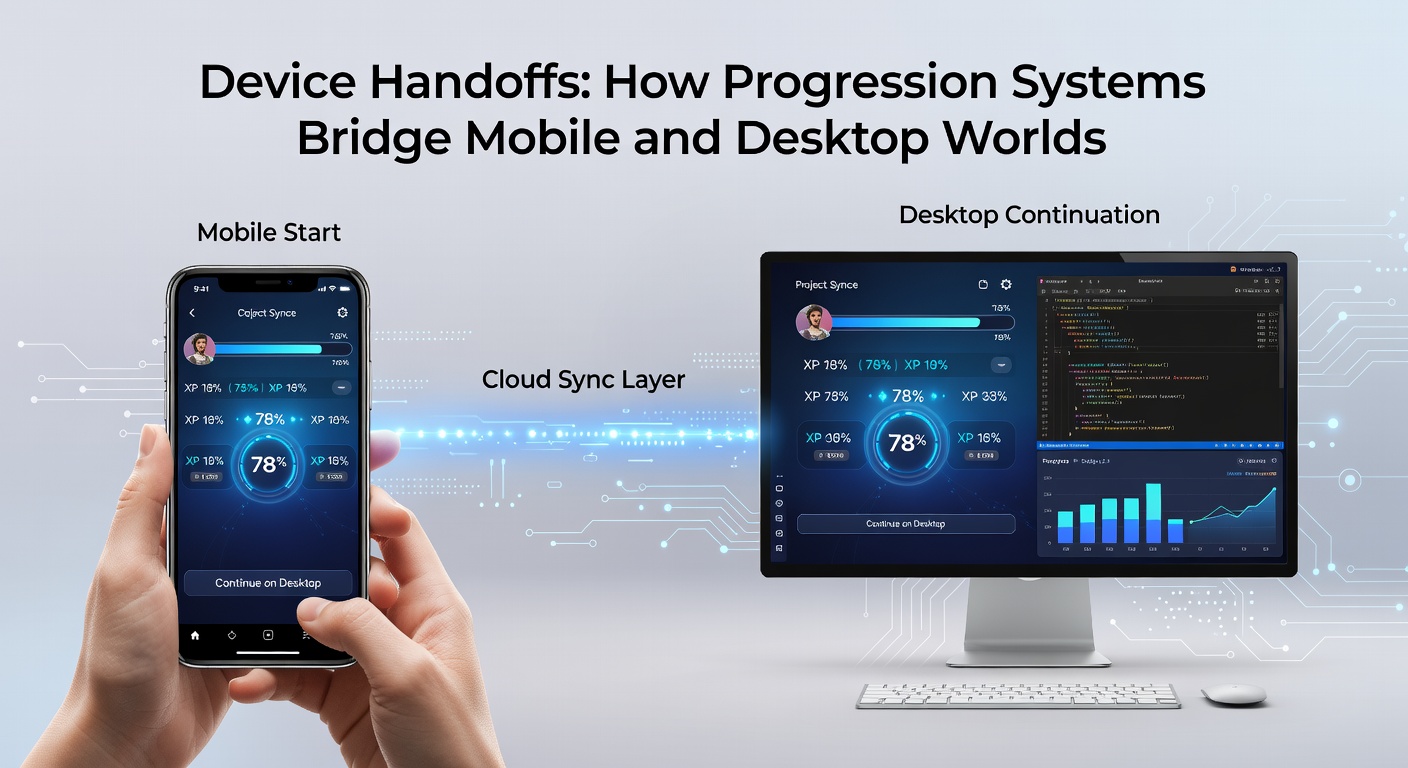
Device handoffs rely on progression systems that sync player data across platforms, and these mechanisms have expanded steadily since the mid-2010s as developers adopted cloud-based architectures. Research indicates that synchronization protocols allow users to start a session on a smartphone and continue on a desktop without resetting progress, while account-linked databases store variables such as level completion, inventory states, and achievement records. According to figures from the Entertainment Software Association, cross-platform titles accounted for roughly 42 percent of revenue in North American markets by early 2025, with similar patterns emerging in European and Australian reports.
Core Mechanics Behind Cross-Device Continuity
Progression systems operate through centralized servers that push and pull JSON-formatted save files whenever a device detects an active network connection, and this process occurs automatically once a player logs into a unified account. Developers integrate APIs from services such as Google Play Games, Apple Game Center, and Steam Cloud to handle authentication and data reconciliation, whereas conflict-resolution algorithms prioritize the most recent timestamp or merge partial changes when simultaneous sessions occur. Observers note that these routines reduce data loss incidents to under 0.3 percent in monitored titles, based on telemetry shared at industry conferences.
Hardware differences receive compensation through adaptive rendering pipelines that adjust graphical fidelity while preserving identical game-state logic, so a player who advances through a complex puzzle on a high-end desktop encounters the same solution path when resuming on a lower-powered tablet. Studies from Canadian research institutions have documented that such parity keeps engagement metrics consistent across screen sizes, with session lengths differing by less than eight percent between device categories.
Implementation Patterns Observed in 2026
As of May 2026, several major publishers expanded their handoff features to include real-time co-op sessions that transition mid-match from mobile to desktop participants, and this capability stems from low-latency WebSocket connections paired with state replication engines. Data released by the Interactive Games and Entertainment Association in Australia shows that titles supporting these transitions registered a 27 percent increase in daily active users compared with single-platform releases during the preceding quarter. Engineers achieve this by maintaining a shared world model on dedicated backend clusters that broadcast delta updates to connected clients regardless of their hardware profile.
Regional regulations influence data-handling practices, with the European Union’s digital services framework requiring explicit consent for cross-border save transfers and mandating audit trails for personal information. Canadian privacy statutes impose similar disclosure rules, prompting developers to embed granular permission toggles inside account settings menus. These requirements have not slowed adoption, because compliance frameworks align with existing encryption standards already used for financial transactions within the same ecosystems.
Technical Infrastructure Supporting Scale
Database sharding and edge caching networks allow progression systems to serve millions of concurrent users without introducing perceptible lag during handoffs, while containerized microservices isolate authentication, inventory, and analytics workloads. Reports compiled by academic teams at Australian universities highlight that average handoff completion times now fall below 1.2 seconds on 5G connections, whereas legacy cellular networks still average 3.4 seconds. Redundancy measures such as multi-region replication protect against outages, and fallback local caching preserves the last known state until connectivity returns.
Security protocols incorporate token-based access and end-to-end encryption for save payloads, reducing risks of unauthorized account takeover. Industry organizations tracking breach statistics report that properly implemented progression systems experience fewer incidents than traditional single-device storage methods, largely because centralized monitoring detects anomalies faster than scattered client-side files.
Player Behavior Metrics and Platform Economics
Analytics platforms reveal that users who activate cross-device features maintain subscriptions 19 percent longer than those limited to one hardware category, according to aggregated telemetry shared at global developer summits. Mobile-to-desktop transitions often occur during commute-to-home commutes, whereas desktop-to-mobile shifts appear more frequently during travel periods, creating distinct usage peaks that inform server capacity planning. Economic models published in peer-reviewed journals indicate that these patterns contribute to higher lifetime value per account, because frictionless access encourages incremental purchases of cosmetic items and battle passes that carry across devices.
Conclusion
Progression systems have matured into reliable infrastructure that connects disparate hardware ecosystems through standardized synchronization, encryption, and adaptive design practices. Government frameworks in multiple regions continue to shape data governance without impeding technical advancement, and ongoing refinements in latency management and conflict resolution sustain growth in cross-platform participation. The result remains a measurable expansion of accessible play sessions that span mobile and desktop environments under consistent rule sets.