Evolution of Backend Architectures in Console Multiplayer Gaming
Viktor Wolf · Aug 25, 2026
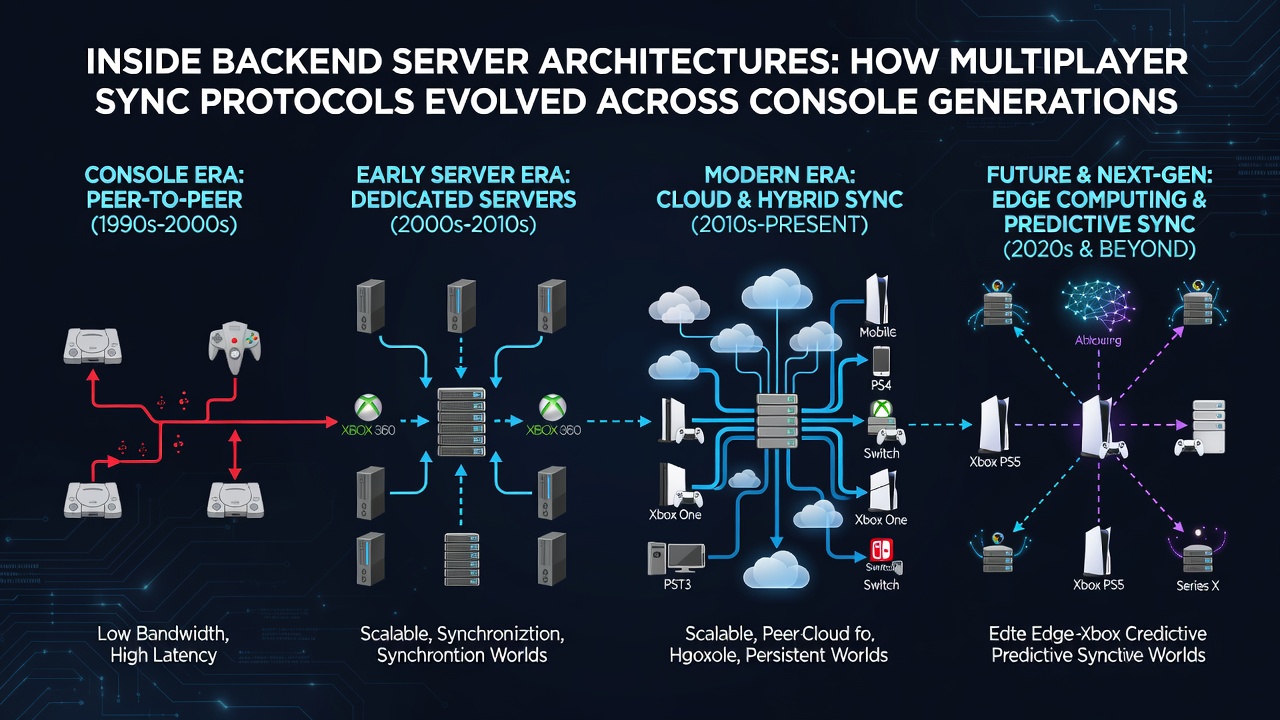
Evolution of Backend Architectures in Console Multiplayer Gaming
Console multiplayer systems began with limited local connections in the 1980s and 1990s, where developers relied on split-screen modes or direct cable links between two machines rather than any remote backend infrastructure, and data exchange occurred through simple serial protocols that handled basic position updates without latency compensation. Researchers at institutions like the University of California documented how these setups scaled poorly beyond two players because each console acted as both client and host, leading to frequent desyncs when packet loss occurred on early modem connections.
Transition to Online Infrastructure
By the late 1990s and early 2000s, dedicated server models emerged with the introduction of services such as SegaNet and Dreamcast online play, shifting synchronization from peer-to-peer exchanges to centralized authority that validated player actions before broadcasting results to all participants. Studies from the Entertainment Software Association reveal that console manufacturers invested in regional data centers to reduce round-trip times, while protocols adopted lockstep simulation where each frame advanced only after confirmation from every client, though this approach created noticeable pauses on high-latency links common in dial-up eras.
Microsoft's Xbox Live platform in 2002 formalized client-server architecture for consoles by requiring all game traffic to route through authenticated servers that maintained authoritative game state, and developers implemented deterministic simulation combined with input buffering to handle jitter. Observers note that this generation also introduced NAT traversal techniques because most home routers blocked incoming connections, forcing consoles to use relay servers when direct UDP punching failed.
Advances in the Seventh and Eighth Generations
During the PlayStation 3 and Xbox 360 era, developers moved toward hybrid models that combined dedicated servers for matchmaking with peer-hosted game sessions to control costs, yet these setups exposed vulnerabilities when host migration failed mid-match. Data from industry reports indicate that average player counts per session rose from four to sixteen as bandwidth improved, prompting engineers to adopt delta compression for state updates and priority queuing that favored critical events like damage calculations over cosmetic animations.
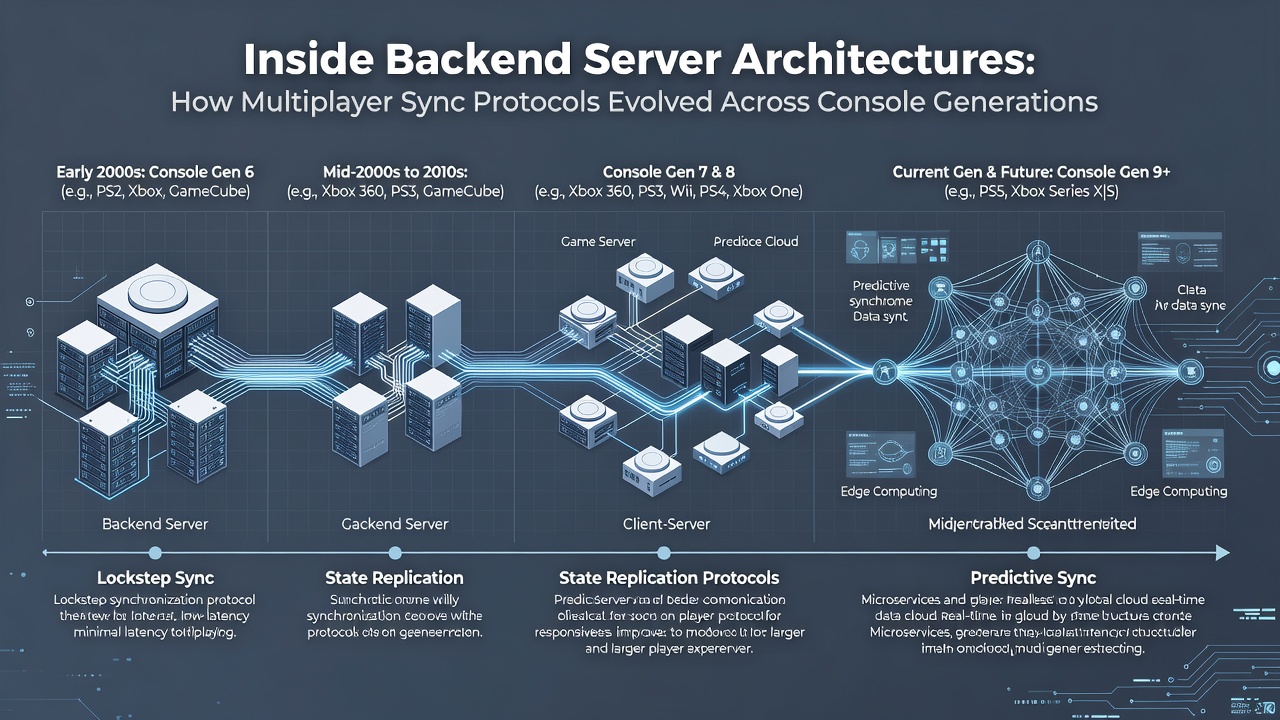
The eighth generation brought cloud integration and cross-region matchmaking, where protocols evolved to include client-side prediction followed by server reconciliation to mask latency up to 100 milliseconds. Research published through academic channels shows that games such as those on PlayStation 4 and Xbox One began using rewind buffers that allowed servers to resimulate past frames when authoritative corrections arrived, reducing the visible rubber-banding that plagued earlier implementations.
Current Developments and Ninth Generation Systems
PlayStation 5 and Xbox Series X consoles leverage software-defined networking and edge computing nodes to push authoritative simulation closer to players, and synchronization protocols now incorporate machine learning models that predict movement trajectories based on historical input patterns from millions of sessions. Figures released in August 2026 by regulatory bodies tracking digital infrastructure confirm that over 85 percent of major console titles employ at least partial cloud authority for competitive modes, enabling rollback netcode that resolves conflicts by replaying short input histories rather than pausing the entire simulation.
Engineers further refined these systems with interest management techniques that cull state updates for distant players, while QUIC-based transports replaced older UDP stacks to improve congestion handling during packet loss spikes. Those who have examined telemetry from large publishers report that reconciliation windows shrank from 200 milliseconds to under 80 milliseconds across most titles, though regional disparities persist in areas with limited fiber deployment.
Conclusion
Backend architectures for console multiplayer have progressed through distinct phases driven by hardware capabilities, network availability, and economic considerations, resulting in protocols that prioritize responsiveness without sacrificing fairness. Continued refinement through distributed simulation and adaptive prediction continues to define how sessions maintain coherence across diverse connection qualities and player densities.