Hardware Specification Patterns: Contrasting Portable and Stationary Gaming Systems
Erik Lange · Jun 11, 2026
Hardware Specification Patterns: Contrasting Portable and Stationary Gaming Systems
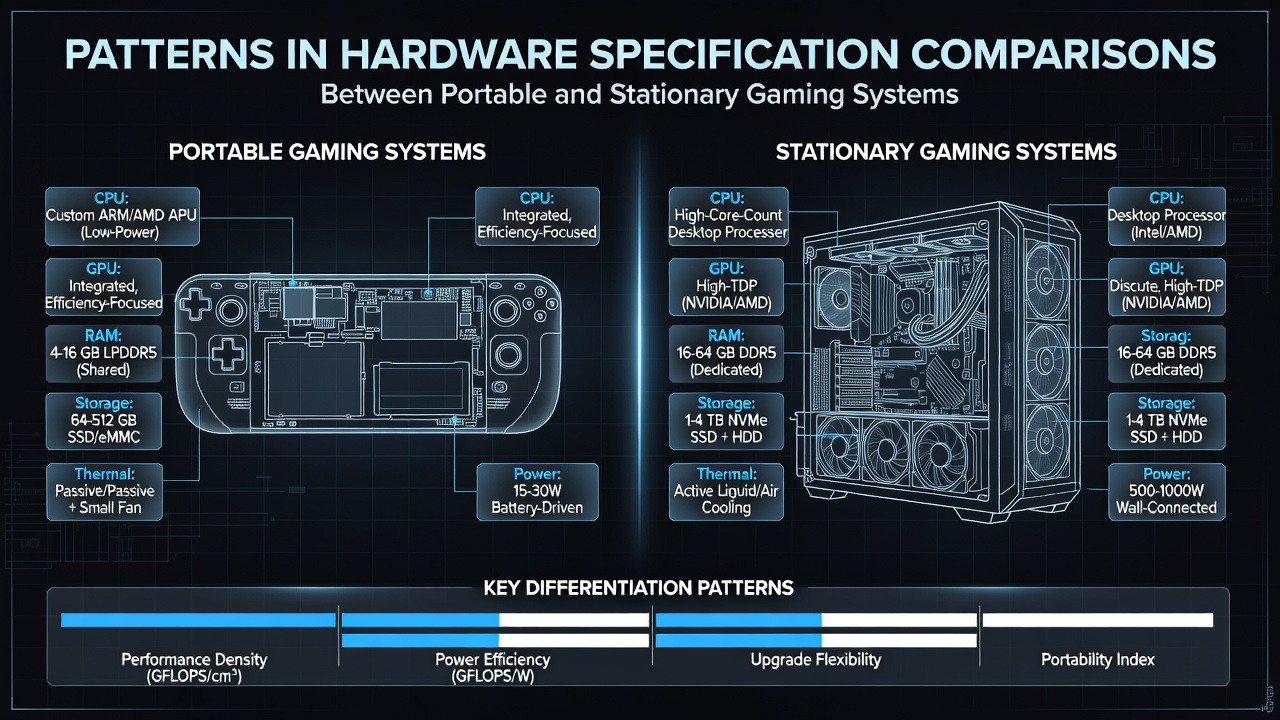
Hardware specifications in gaming devices reveal consistent patterns when portable systems face off against their stationary counterparts, and data from multiple industry analyses tracks these differences across generations. Portable devices prioritize power efficiency and compact form factors while stationary platforms leverage higher thermal headroom for sustained performance, yet both categories show converging trends in memory bandwidth and storage speeds as of June 2026.
CPU and GPU Architecture Trends
Central processing units in portable gaming hardware typically operate at lower clock speeds than those found in stationary consoles because thermal limits and battery constraints dictate conservative designs, although recent chip iterations from manufacturers have narrowed the gap through improved node processes. Graphics processing units follow similar logic where portable variants integrate fewer compute units and reduced memory interfaces yet maintain compatibility layers that allow shared game engines to scale across platforms. Researchers at various institutions note that these architectural choices create predictable performance deltas, with stationary systems often delivering two to three times the floating-point operations per second under equivalent software loads.
Memory Configurations and Bandwidth
Random access memory allocations have grown steadily in both device types, and portable units now frequently ship with 8 to 16 gigabytes of LPDDR5X or faster variants while stationary consoles allocate 16 to 24 gigabytes of GDDR6 or GDDR6X. Bandwidth figures remain lower on portables due to narrower bus widths, yet system-on-chip integration reduces latency penalties and enables efficient data movement between CPU, GPU, and unified memory pools. Industry reports indicate that this unified memory approach appears more frequently in newer portable designs, mirroring techniques long established in stationary hardware.
Storage and Connectivity Specifications
Solid-state drive capacities and interface speeds present another clear pattern where stationary systems adopt larger, faster NVMe drives earlier than portables because internal space and power budgets allow for premium components. Portable devices have adopted UFS or PCIe-based storage solutions at a rapid pace, and transfer rates now approach those of mid-tier stationary consoles released two generations prior. Connectivity features such as Wi-Fi 6E and Bluetooth 5.3 appear across both categories with comparable implementation timelines, although stationary platforms add more extensive Ethernet and expanded I/O options as standard.
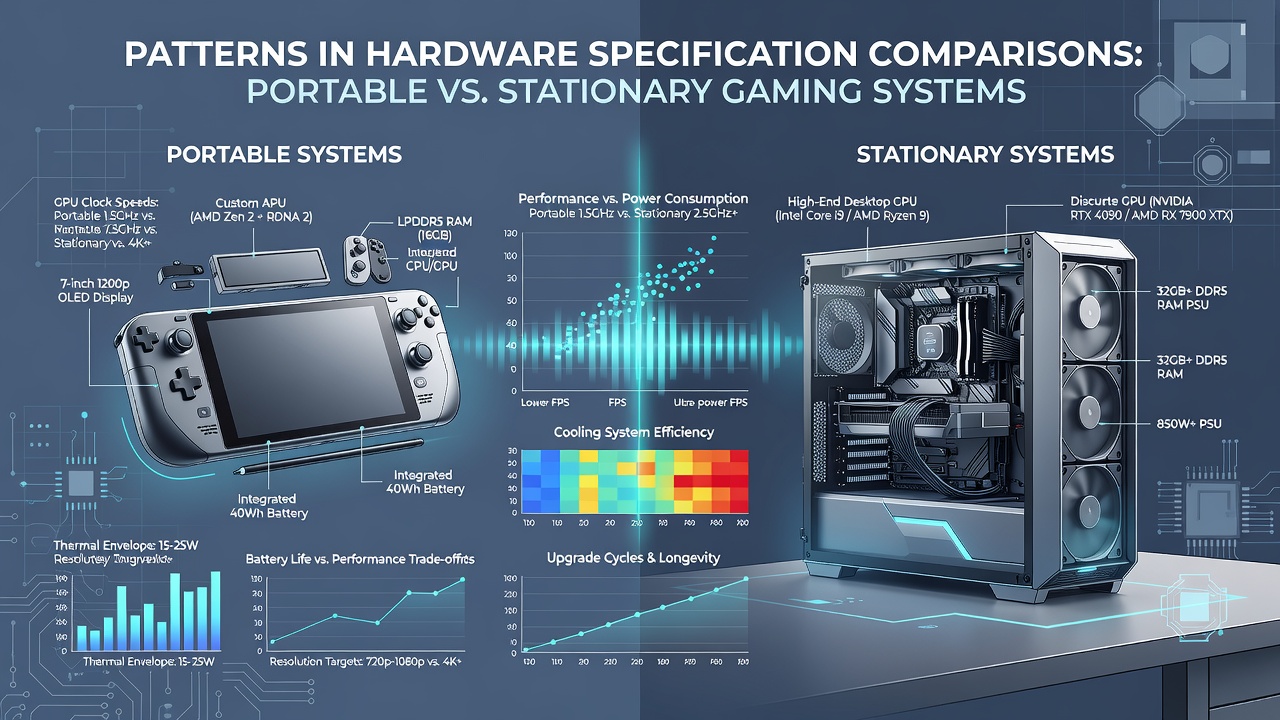
Power delivery systems diverge sharply because portable hardware must balance performance against runtime, and this constraint drives adoption of aggressive voltage scaling and dynamic frequency adjustments that stationary consoles apply less stringently. Thermal solutions in stationary devices often incorporate larger heatsinks and multiple fans, enabling higher sustained wattage envelopes that reach 200 watts or more for combined CPU and GPU packages, whereas portable units cap total system power closer to 15 to 30 watts during intensive sessions.
Market Data and Cross-Platform Development
Figures from the Entertainment Software Association highlight how development budgets increasingly account for specification parity across device classes, and this shift has encouraged middleware solutions that automatically adjust rendering resolutions and effects based on detected hardware profiles. European Union technology assessments similarly document rising performance-per-watt metrics in portable silicon, driven by regulatory emphasis on energy efficiency across consumer electronics. Academic studies from institutions in Canada and Australia further track how these efficiency gains translate into longer play sessions without sacrificing graphical fidelity in optimized titles.
Emerging Patterns in June 2026
By June 2026, several portable systems incorporate ray-tracing acceleration blocks previously reserved for stationary flagships, and stationary platforms continue to push rasterization and compute density higher through chiplet designs. Observers note that shared software ecosystems reduce the effective performance gap because developers optimize once and scale assets accordingly rather than maintaining entirely separate code paths. Storage expansion via microSD or external SSDs has become standard on portables, closing another practical difference that once separated the two categories.
Power Efficiency and Thermal Management
Thermal throttling behavior creates measurable patterns in benchmark data where portable devices reduce clock speeds after minutes of load while stationary consoles maintain near-peak output for extended periods. Advanced cooling materials such as vapor chambers now appear in select high-end portables, and these additions extend the duration before throttling occurs without increasing overall device thickness dramatically. Stationary systems benefit from active liquid cooling options in enthusiast configurations, yet baseline models rely on refined air cooling that has improved incrementally rather than through revolutionary redesigns.
Those who analyze teardown reports and official specification sheets consistently find that portable hardware allocates a larger percentage of its power budget to display and wireless radios compared with stationary counterparts, which dedicate more resources to raw compute. This allocation influences game design choices around frame rates and visual complexity, and it explains why many cross-platform titles target 30 or 60 frames per second on portables while offering unlocked or higher rates on stationary hardware.
Conclusion
Specification patterns between portable and stationary gaming systems continue to evolve through incremental refinements rather than abrupt shifts, and these trends support broader accessibility as development tools mature. Data from regulatory bodies and research organizations shows steady convergence in key areas such as memory technology and connectivity standards while fundamental differences in power and thermal envelopes persist. Continued monitoring of silicon roadmaps will clarify how far this convergence extends in subsequent hardware cycles.