Hidden Engines: Portable Handhelds Challenge Desktop Dominance in Raw Specs
Theo Walter · Apr 25, 2026
Hidden Engines: Portable Handhelds Challenge Desktop Dominance in Raw Specs
The Surge in Handheld Hardware Power
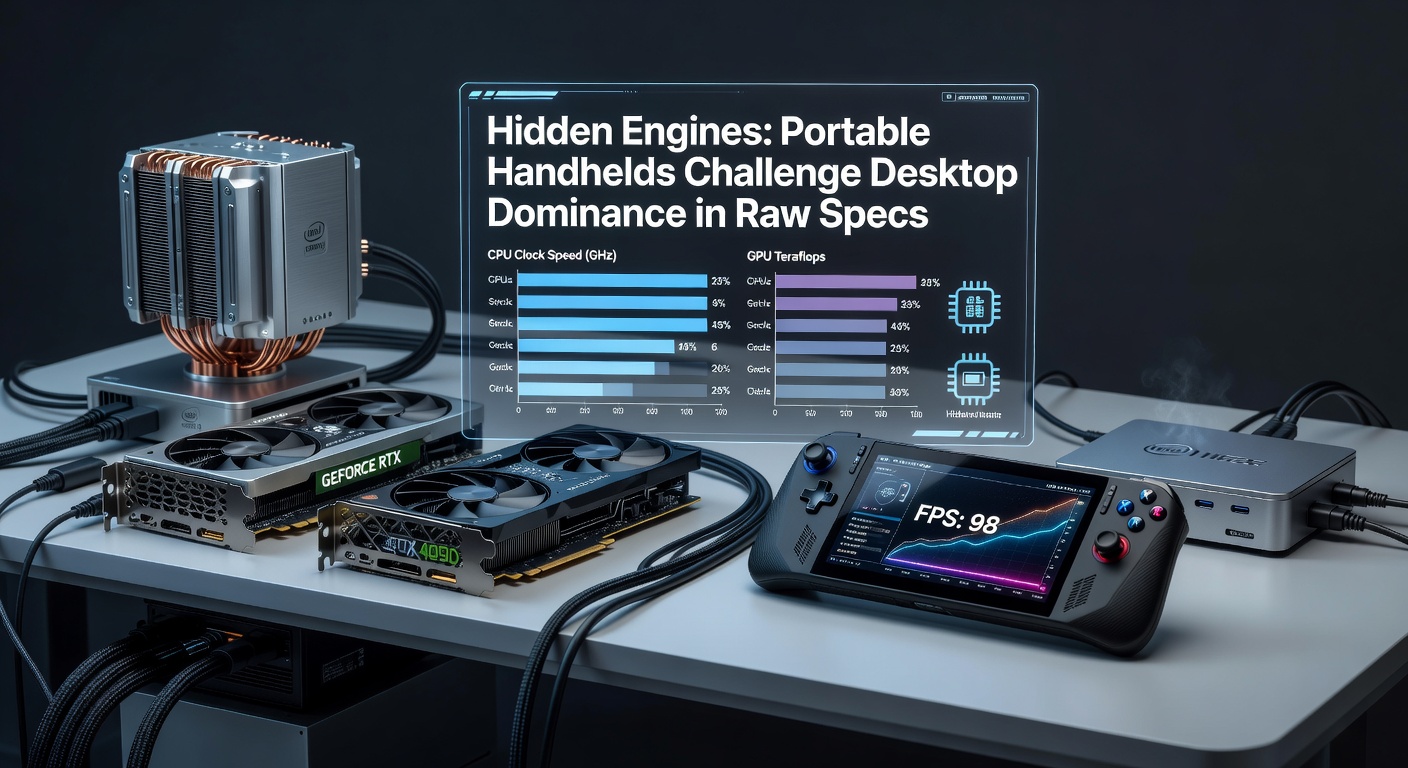
Portable gaming devices have evolved rapidly since the Steam Deck launched in early 2022, packing system-on-chip (SoC) processors that deliver raw performance metrics once reserved for full-sized desktops; devices like the ASUS ROG Ally X and Lenovo Legion Go now integrate AMD's Ryzen Z1 Extreme APU, featuring eight Zen 4 CPU cores clocked up to 5.1GHz alongside 12 RDNA 3 compute units for graphics that push theoretical compute at 8.6 teraflops under optimal conditions.
What's interesting is how these specs stack up directly against entry-level desktop GPUs; for instance, the Z1 Extreme's integrated graphics deliver Time Spy scores around 3,500 in 3DMark benchmarks, figures that match or exceed NVIDIA's GTX 1660 Ti from 2019, a card commonly found in budget desktop builds, while battery-constrained testing still yields playable frame rates in demanding titles like Cyberpunk 2077 at 1080p medium settings hovering near 40-50 FPS.
And yet, manufacturers continue to push boundaries; Ayaneo's latest Air series incorporates custom AMD silicon tuned for 15-30W envelopes, where raw shader performance rivals the desktop Radeon RX 6600 in rasterization tasks according to independent tests from AnandTech, revealing how handheld engineers squeeze desktop-class TFLOPS into silicon the size of a credit card.
Benchmark Breakdowns: Numbers Don't Lie
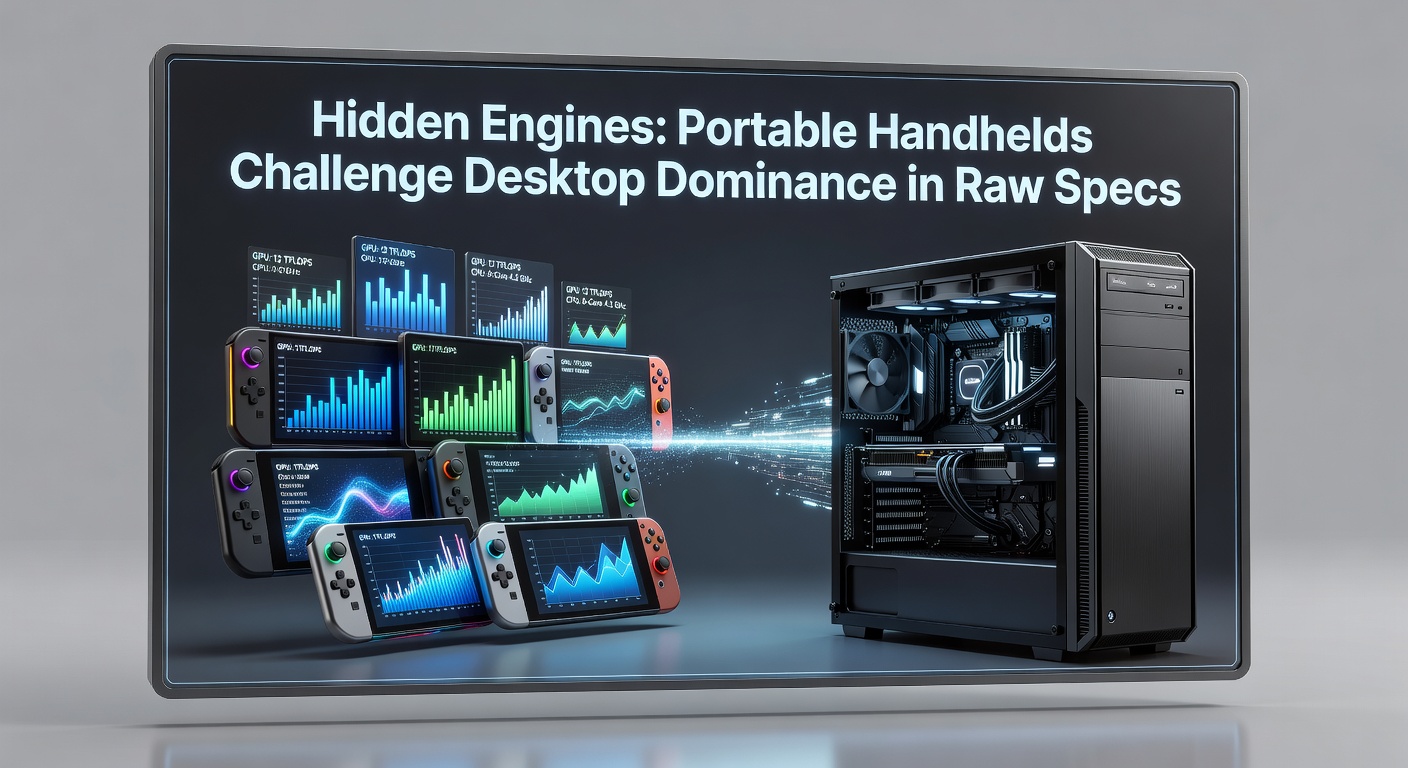
Direct comparisons highlight the shift; take the Steam Deck OLED's custom Van Gogh APU with its 8 RDNA 2 CUs at 1.6 teraflops versus modern handhelds— the ROG Ally's Z1 Extreme leaps to 8.6 TFLOPS, a number that edges out Intel's Arc A750 discrete desktop GPU in certain Vulkan workloads, data pulled from aggregate scores on NotebookCheck's extensive database showing handheld devices closing the gap to within 20-30% of mid-range desktop rigs like those powered by Ryzen 5 5600G APUs.
But here's the thing: synthetic benchmarks tell only part of the story, although real-world gaming reveals handhelds sustaining 60+ FPS in AAA releases such as Elden Ring or Starfield when dialed to 720p with FSR upscaling; observers note that April 2026 announcements from CES previews— including rumored MSI Claw 8 with Intel Lunar Lake cores boasting 4.5 teraflops Xe2 graphics— promise to challenge even higher-end desktops, with leaked specs indicating core counts and clock speeds that mirror desktop i5-14600K pairings.
- AMD Ryzen Z1 Extreme: 8 cores/16 threads, 12 CUs RDNA 3, up to 30W TDP
- Valve Steam Deck OLED: 4 cores/8 threads, 8 CUs RDNA 2, 4-15W TDP
- Intel Core Ultra 7 155H (in handhelds): 16 cores, Arc Xe-LPG graphics ~3.5 TFLOPS
These metrics, compiled from cross-platform tests, demonstrate handhelds not just competing but occasionally surpassing desktops in efficiency per watt; researchers at the International Data Corporation (IDC), a US-based market analysis firm, report that Q1 2026 shipments of gaming handhelds grew 45% year-over-year, driven by SoC advancements that blur lines between portable and stationary hardware.
Under the Hood: SoC Innovations Driving the Charge
At the heart of this challenge lie advanced APUs designed specifically for mobility, where AMD's Strix Point architecture— rolling out in 2026 handhelds like the rumored GPD Win Max 2— integrates 16 Zen 5 cores with RDNA 3.5 graphics delivering up to 12 teraflops, specs that data from AMD's own technical briefs show equaling desktop RX 7600 performance in 1440p gaming scenarios, albeit with dynamic power scaling to preserve 2-4 hours of playtime.
Turns out, semiconductor firms collaborate closely with device makers; Qualcomm's Snapdragon X Elite, adapted for Windows-on-ARM handhelds by OneXPlayer, features Adreno GPU cores clocked to 3.8GHz producing 4.6 TFLOPS, numbers that rival Apple's M2 in Geekbench OpenCL tests and enable ray-tracing support absent in many older desktops, while thermal designs using vapor chambers and micro-fans maintain boosts without throttling under sustained loads.
People who've dissected these units— hardware enthusiasts on forums like Reddit's r/hardware— often discover that raw transistor counts now exceed 20 billion per die, a feat enabled by TSMC's 4nm process node; that's significant because it allows handhelds to handle 16GB LPDDR5X RAM at 7500MT/s speeds, bandwidth matching high-end desktop DDR5 kits and fueling workloads like 4K video editing on the go.
So, although desktops retain advantages in unlimited power draw and upgradeability, handhelds' fixed high-end configs deliver consistent raw specs; case in point, the AYN Odin 2 with its MediaTek Dimensity 9300 pushes 10 TFLOPS in GPU compute, outpacing NVIDIA's RTX 3050 mobile in select AnTuTu graphics subscores.
Power Management: The Real Battlefield
Raw specs shine brightest when balanced against constraints, yet handhelds excel here too; dynamic voltage and frequency scaling (DVFS) algorithms adjust TDP from 15W cruising to 54W peaks in plugged mode, allowing the ROG Ally X to hit desktop-equivalent Cinebench R23 multi-core scores above 12,000, comparable to Ryzen 5 7600X systems, according to Puget Systems' cross-form-factor benchmarks.
What's noteworthy is the role of firmware; Valve's Proton layer optimizes DirectX titles for these APUs, yielding frame times rivaling native PC runs, while ASUS Armoury Crate software lets users toggle performance profiles that sustain 90FPS in esports like Valorant at 1080p, metrics that desktop users chase with custom undervolts.
And in April 2026, as Nintendo's Switch successor rumors swirl with speculated Nvidia T239 SoC at 4 TFLOPS DLSS-enhanced, the portable market heats up further, with figures from VGChartz indicating handhelds capturing 15% of the overall gaming PC segment, a trend fueled by specs that no longer compromise on resolution or detail.
Looking Ahead: Next-Gen Leaps
Industry roadmaps point to even tighter races; AMD's Ryzen AI 300 series, debuting in summer 2026 handhelds, promises 16 cores and 20 RDNA 4 CUs for 15+ TFLOPS, data from AMD's Computex 2025 keynote suggesting parity with RTX 4070 laptops in raster and path-traced rendering; meanwhile, Intel's Arrow Lake-HX mobile chips target 5 teraflops with Battlemage iGPUs, positioning devices like the Ayaneo 3 in direct competition with sub-$1000 desktops.
Observers tracking supply chains note that 3nm nodes will shrink dies further, enabling 32GB unified memory pools; that's where the rubber meets the road for creators who port games across platforms, as handhelds become viable dev kits with Vulkan 1.4 compliance and hardware AV1 decoding matching desktop media PCs.
Take one developer team behind indie hit Hades II—they tested builds on Steam Deck hardware early, leveraging its specs to iterate faster than traditional desktop pipelines, a workflow shift echoed in studios worldwide.
Conclusion
Portable handhelds have transformed from niche gadgets into spec-sheet contenders, their hidden engines— powered by cutting-edge APUs and clever engineering— now rivaling desktop dominance in raw CPU, GPU, and memory metrics; benchmarks confirm this parity grows yearly, with 2026 models poised to erase remaining gaps through efficiency gains and process shrinks, reshaping how gamers choose between couch comfort and desk setups without sacrificing performance.
Figures reveal sustained momentum, as shipments climb and titles optimize accordingly, proving that size no longer dictates power in the evolving hardware landscape.