Portable Silicon: The Architectures Guiding Indie Mechanics
Erik Lange · Jul 11, 2026
Portable Silicon: The Architectures Guiding Indie Mechanics
Portable device hardware continues to define boundaries and opportunities for independent game creators who target phones, tablets, and handheld consoles, with specific chip designs channeling mechanics toward efficient input handling, power management, and rendering techniques that fit within thermal and battery limits. Research from institutions such as the IEEE indicates that ARM-based system-on-chips dominate these platforms because their heterogeneous core layouts allow developers to allocate tasks between performance and efficiency cores without constant context switching overhead.
Unified Memory Models and Physics-Driven Interactions
Apple's M-series and A-series chips incorporate unified memory architectures that let indie teams implement detailed physics simulations in games where objects interact in real time on screen, since data transfers between CPU and GPU occur at lower latency compared with discrete memory pools on older mobile SoCs. This configuration supports mechanics like destructible environments or ragdoll effects that run consistently across multiple sessions without requiring constant asset streaming from storage. Developers working on devices released before July 2026 often cite these memory layouts as the reason certain touch-based puzzle games incorporate layered collision detection that would exceed bandwidth on separated memory systems.
Thermal Throttling Patterns and Session Design
Qualcomm Snapdragon and MediaTek Dimensity processors found in many Android handhelds trigger dynamic frequency scaling once internal temperatures rise above set thresholds, which leads designers to create gameplay loops built around shorter focused bursts rather than extended continuous play. Data from industry reports compiled by the Entertainment Software Association shows that titles optimized for these thermal profiles include auto-pause features or checkpoint systems that activate at predictable intervals, preserving battery life while maintaining player engagement. Observers note that this hardware behavior has encouraged mechanics such as asynchronous multiplayer turns that complete in background processes, letting users resume without reloading full scenes.
GPU Tile-Based Rendering and Visual Style Choices
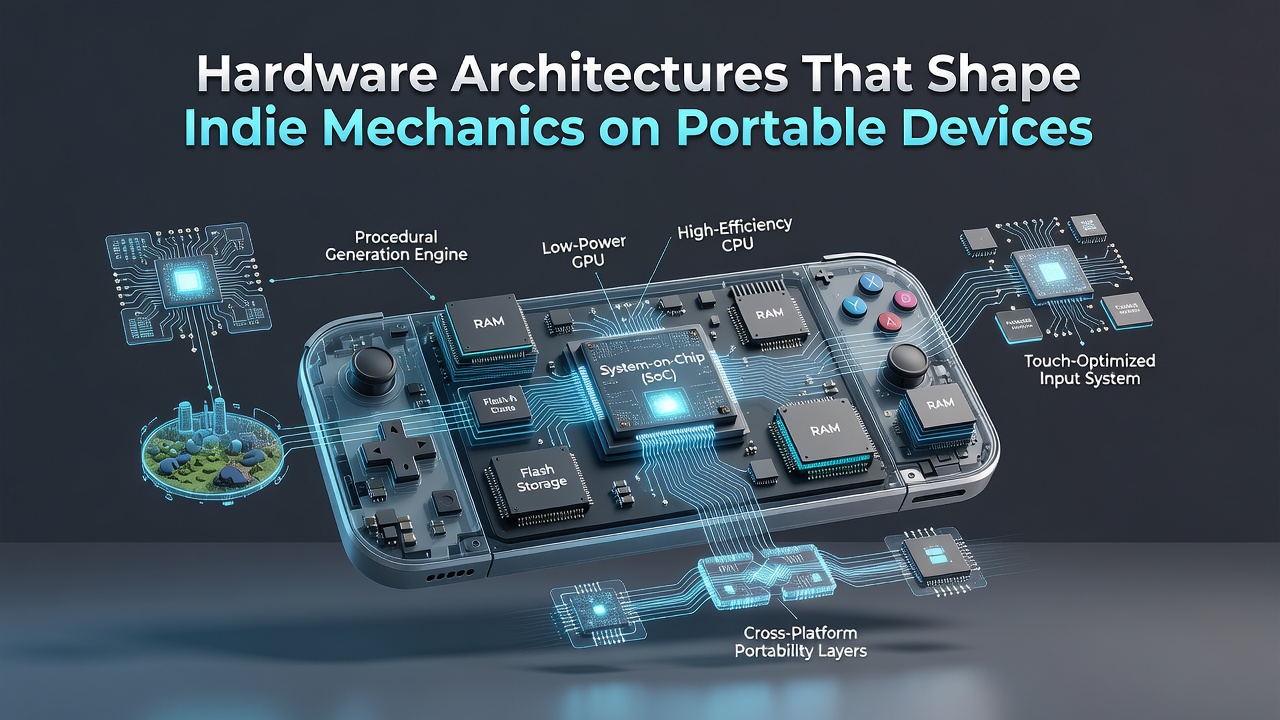
Tile-based deferred rendering pipelines common in Mali and Adreno GPUs encourage indie developers to favor stylized 2D art or low-polygon 3D models because these architectures process fragments in small tiles that reduce overdraw penalties on smaller screens. Studies published through academic channels including work affiliated with technical universities in Germany reveal that games leveraging these pipelines achieve higher frame consistency when limiting particle counts and post-processing effects, which in turn shapes visual narratives around minimalist aesthetics rather than photorealistic detail. In July 2026 several new handheld variants entered testing phases with updated GPU drivers that further refined tile allocation algorithms, giving small teams additional headroom for layered sprite systems without sacrificing input responsiveness.
Input Controller Integration and Hybrid Control Schemes
Devices such as the Nintendo Switch utilize custom Nvidia Tegra processors paired with detachable Joy-Con controllers, creating hardware pathways that indie studios exploit for mechanics combining motion sensing with traditional button inputs. This integration allows precise timing-based actions where gyroscope data feeds directly into game logic without intermediate translation layers, supporting genres like rhythm games or precision platformers that adapt to both handheld and docked configurations. Figures released by regulatory bodies including the Canadian Intellectual Property Office track rising patent activity around these hybrid input mappings, confirming that architecture-specific APIs guide how developers map gestures to core gameplay loops.
Storage Speed and Asset Streaming Approaches
UFS 4.0 and PCIe-based storage controllers in recent portable hardware reduce load times enough for indie creators to stream environmental assets during active gameplay instead of relying on pre-load screens, enabling seamless world transitions in open-ended exploration titles. Research indicates that this storage throughput works in tandem with compression formats tailored to mobile GPUs, allowing teams to maintain visual fidelity while keeping overall package sizes suitable for digital distribution platforms. Those who have examined cross-platform builds note that games designed around these faster interfaces often incorporate procedural generation for background elements to further minimize static asset footprints.
Conclusion
Hardware architectures on portable devices continue to steer indie mechanics toward solutions that balance performance, power, and input precision, with each generation of chipsets introducing new constraints and capabilities that shape design decisions across global development teams. As of July 2026 the patterns established by unified memory, thermal management, tile rendering, and storage integration remain central to how small studios deliver distinctive experiences within the physical limits of handheld platforms.