Seamless Save Protocols Driving Shifts in Multi-Platform Player Engagement
Erik Lange · Aug 22, 2026

Seamless Save Protocols Driving Shifts in Multi-Platform Player Engagement
Cross-platform save protocols have gained traction in recent years as developers integrate cloud-based synchronization into titles spanning mobile, console, and desktop environments, and data from industry reports shows increased adoption rates through 2025 into August 2026. These systems allow players to maintain progress without interruption when moving between devices, which alters daily routines for many users who previously restarted or accepted fragmented experiences on separate platforms.
Core Mechanics Behind Current Protocols
Modern implementations rely on standardized APIs and cloud storage solutions that store player data in centralized servers, while local caching handles offline sessions before automatic uploads occur upon reconnection. Companies such as those behind major engines have adopted formats compatible with multiple operating systems, and this compatibility reduces the need for manual transfers that once required external tools or manual file management. Research from the Entertainment Software Association indicates that titles supporting these features see higher completion rates across device types compared to those without synchronization.
Engineers design these protocols to handle variable network conditions, which means data conflicts receive resolution through timestamp-based merging or version control algorithms that prioritize the most recent actions. Console manufacturers have incorporated native support in their online services, whereas mobile platforms leverage app store frameworks to enable background syncing, and desktop applications connect through dedicated launchers that authenticate across ecosystems.
Observed Changes in Player Routines
Players now frequently alternate between short mobile sessions during commutes and longer console or desktop play in the evenings, because progress carries forward without loss. Studies compiled by research firms tracking user behavior reveal that average session lengths on secondary devices have increased since widespread protocol rollout, as users trust the system to preserve achievements and inventory states. This pattern appears across genres including role-playing games, strategy titles, and action adventures where character development spans extended periods.
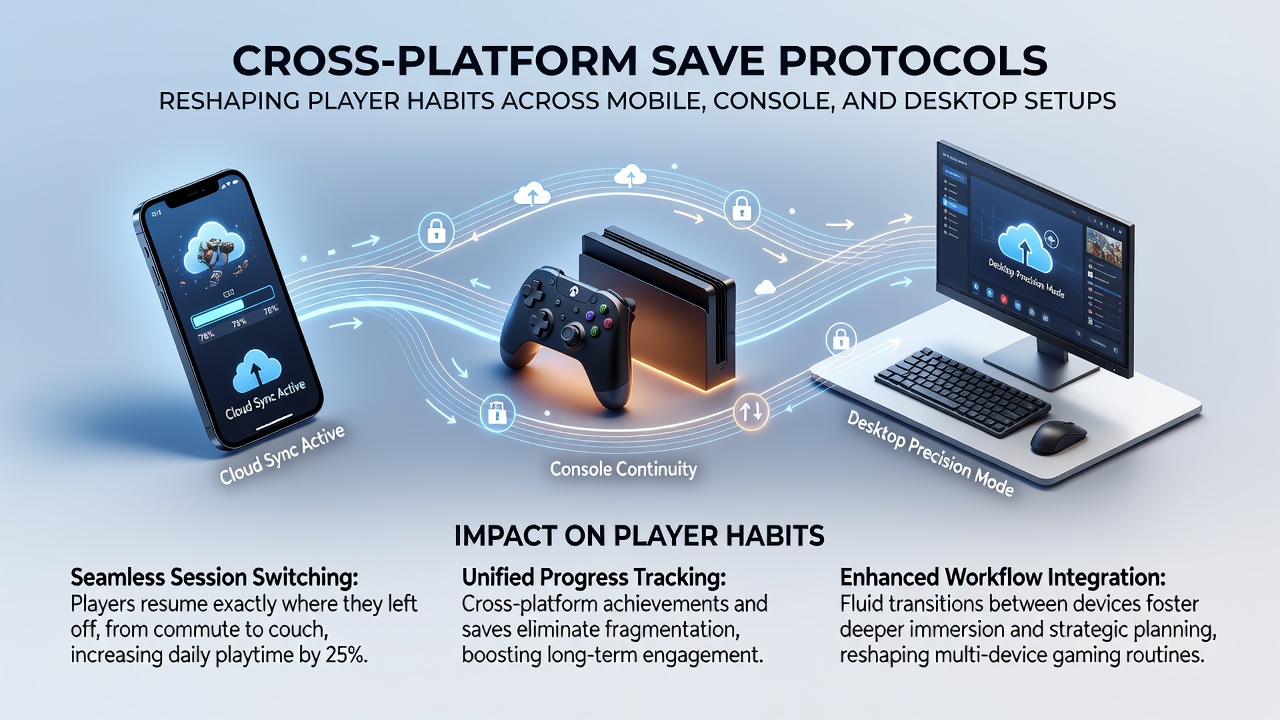
Community forums and analytics dashboards document cases where users complete quests started on one platform while traveling, then resume refinements on a larger screen at home. Device manufacturers have noted corresponding rises in accessory sales, such as controllers compatible with multiple systems, since seamless saves encourage hardware experimentation without fear of duplicated effort. Figures from academic papers on digital media consumption highlight that households with mixed device ownership report more shared accounts and collaborative play when saves remain unified.
Technical and Industry Developments Through 2026
Updates in August 2026 introduced enhanced encryption standards for save files transmitted between devices, addressing security concerns raised in prior audits while maintaining performance on lower-powered hardware. Trade groups including the Interactive Software Federation of Europe have published guidelines encouraging interoperability, which has prompted smaller studios to adopt open-source synchronization libraries rather than building proprietary solutions from scratch. These libraries support cross-region play in some instances, allowing accounts created in one market to function elsewhere without additional configuration.
Hardware limitations still influence implementation details, because mobile processors handle background tasks differently than dedicated console chips or desktop GPUs, yet protocol designers compensate through compression techniques that minimize bandwidth use during transfers. Observers tracking patent filings note a steady increase in methods for conflict resolution and partial syncs, which permit large worlds to update only changed sections instead of entire files.
Broader Ecosystem Effects
Distribution platforms have adjusted their policies to accommodate unified accounts, resulting in shared marketplaces where purchases unlock across linked devices. This shift has streamlined monetization for publishers, who track engagement metrics that span platforms rather than treating each as an isolated channel. Data aggregated by university-led research groups demonstrates correlations between protocol availability and reduced player churn, particularly in free-to-play models where retention hinges on continuous access to accumulated resources.
Developers report streamlined testing cycles once core save logic stabilizes, although edge cases involving network outages or account migration between services require ongoing attention. Regional variations persist, with some markets emphasizing offline-first designs due to connectivity challenges, while others prioritize real-time updates for competitive modes.
Conclusion
Cross-platform save protocols continue to integrate deeper into development pipelines as hardware ecosystems diversify, and available evidence points to sustained influence on how individuals structure their gaming time across mobile, console, and desktop setups. Ongoing refinements in security, speed, and compatibility suggest further evolution in the coming periods, driven by both technical capabilities and user expectations documented in multiple industry analyses.