Shifting Console Firmware Dynamics: How Developer Patches Reshape Performance Boundaries in Mixed Hardware Environments
Erik Lange · Aug 31, 2026

Shifting Console Firmware Dynamics: How Developer Patches Reshape Performance Boundaries in Mixed Hardware Environments
Console manufacturers continue to release firmware updates that modify core system behaviors, and developer patches often follow to leverage these changes for better optimization in environments where hardware varies widely. These adjustments target memory management, thermal throttling, and rendering pipelines, which allows games to maintain consistent performance whether they run on current-generation units or older models paired with external hardware like capture cards or networked PCs.
Firmware Evolution Patterns Across Major Platforms
Sony and Microsoft issue regular firmware revisions that alter how processors allocate resources during gameplay sessions, while Nintendo focuses updates on handheld-to-dock transitions that affect power scaling. Research from the IEEE shows that these revisions frequently include kernel-level tweaks which developers then address through targeted patches that recalibrate game engines for the new parameters. Observers note that such coordinated efforts have become standard practice since multi-platform titles must operate within ecosystems that blend native console hardware with streaming devices and cloud renderers.
Patches released after firmware drops often address stability in mixed setups where one console connects to another via local networks or shares processing tasks with a PC rig. Data from industry reports indicate that these updates reduce input latency in cross-device sessions by adjusting buffer sizes and synchronization protocols, and they achieve this without requiring users to upgrade physical components.
Performance Shifts in Heterogeneous Hardware Configurations
Developers test patches against configurations that combine different console revisions with external displays and input devices, which reveals how firmware changes expand or contract available performance headroom. For instance, an update that improves GPU scheduling on one platform can enable higher resolution outputs when the same game runs on a lower-spec unit connected through a compatibility layer. Those who monitor these dynamics report that August 2026 saw several simultaneous firmware releases across platforms that prompted coordinated patch deployments, resulting in measurable gains for titles operating in environments with mixed storage speeds and network conditions.
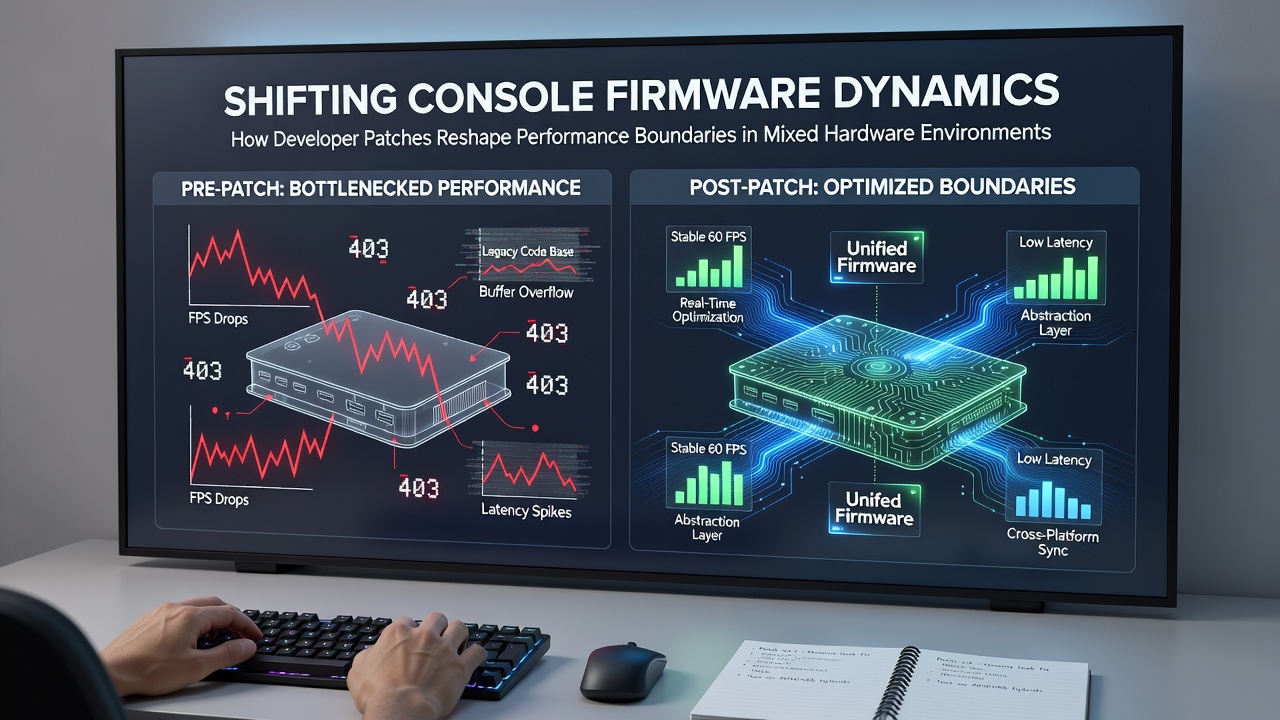
Engine optimizations within these patches frequently involve reallocation of CPU threads and adjustments to shader compilation routines, and such modifications allow games to sustain frame targets even when hardware clocks vary due to thermal limits or power delivery differences. Studies conducted by research groups at institutions like the University of Tokyo have documented cases where post-firmware patches restored performance parity across console variants that previously showed divergent results under identical game code.
Developer Strategies for Cross-Generation Compatibility
Teams responsible for multi-platform releases now build patch pipelines that account for firmware revision histories, which helps them predict how each update cycle will influence boundary conditions in mixed hardware. These strategies include conditional code paths that activate based on detected system versions, and they deliver consistent behavior whether the environment features a single console generation or a blend of legacy and current units. Figures from the Entertainment Software Association reveal that adoption rates for such adaptive patches have risen steadily as developers gain access to more granular telemetry from diverse hardware deployments.
Patches also incorporate fixes for edge cases that emerge when firmware alters security or networking stacks, and these changes affect how data moves between devices in shared play sessions. Experts at organizations such as the Canadian Interactive Digital Entertainment Association have tracked instances where updates improved compatibility with third-party peripherals, thereby extending usable performance margins without additional hardware investment.
Conclusion
Developer patches continue to interact with console firmware revisions in ways that redefine operational limits across varied hardware combinations, and ongoing coordination between manufacturers and studios sustains these incremental shifts. Data collected through established industry channels shows that the pattern persists as new firmware cycles introduce variables that patches must resolve to maintain expected performance levels.