Storage Innovations Driving Level Design Shifts in Contemporary Console and Mobile Releases
Carlo Peters · Aug 20, 2026
Storage Innovations Driving Level Design Shifts in Contemporary Console and Mobile Releases
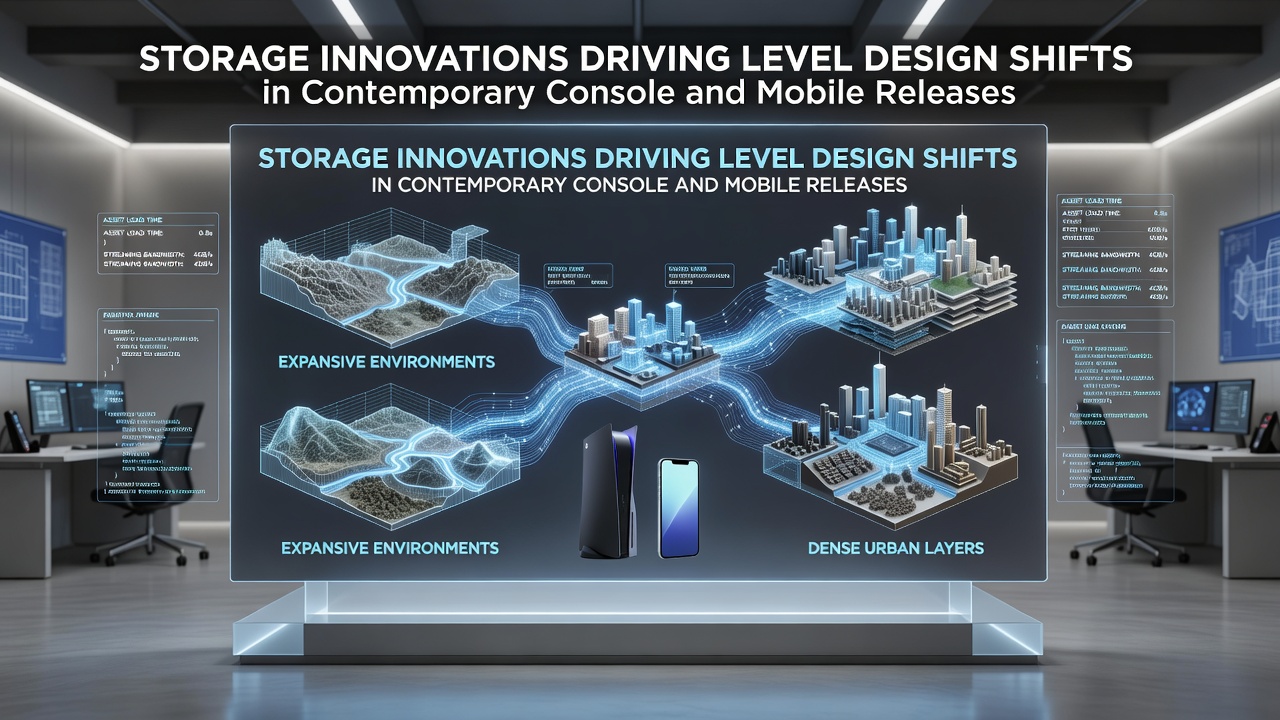
Storage speed has emerged as a foundational element reshaping how developers approach level architecture in console and mobile titles, with hardware advancements allowing data to flow directly into active gameplay rather than pausing for traditional loads. Industry reports indicate that custom solid-state drives in systems like PlayStation 5 and Xbox Series X deliver read speeds exceeding 5 GB per second, which supports continuous asset streaming across expansive environments without discrete transition screens.
Researchers at technical institutions have documented how these throughput rates permit designers to construct worlds where players move between biomes or urban districts through fluid transitions, relying on predictive loading algorithms that pull geometry, textures, and scripts in real time. Data from hardware analyses shows this capability reduces reliance on pre-baked loading zones, freeing creative teams to prioritize verticality and interconnected spaces that would strain older mechanical drives.
Console Hardware Changes and Resulting Design Patterns
Console manufacturers integrated decompression hardware directly into storage controllers, a step that offloads texture unpacking and asset decompression from the main CPU, according to technical specifications released by platform holders. This integration means level designers can embed denser detail layers, such as destructible environments or layered weather systems, because the pipeline sustains higher simultaneous data requests during play sessions.
One study from European gaming research groups found that titles released after 2020 increasingly feature open-zone structures where memory management routines swap high-fidelity models in and out based on player proximity, rather than entire map reloads. Observers note examples where exploration loops expand because fast storage eliminates the need for artificial bottlenecks that once gated progress behind save points or elevators.
Mobile Storage Evolution Supporting Similar Shifts
Mobile devices have adopted UFS 4.0 and comparable high-bandwidth flash standards that push sequential read rates past 4 GB per second on flagship handsets, enabling developers to stream larger asset packages during on-the-go sessions. Figures from component suppliers reveal that these interfaces cut latency for random I/O operations, which proves critical when games must maintain frame consistency while pulling environmental data from internal storage.
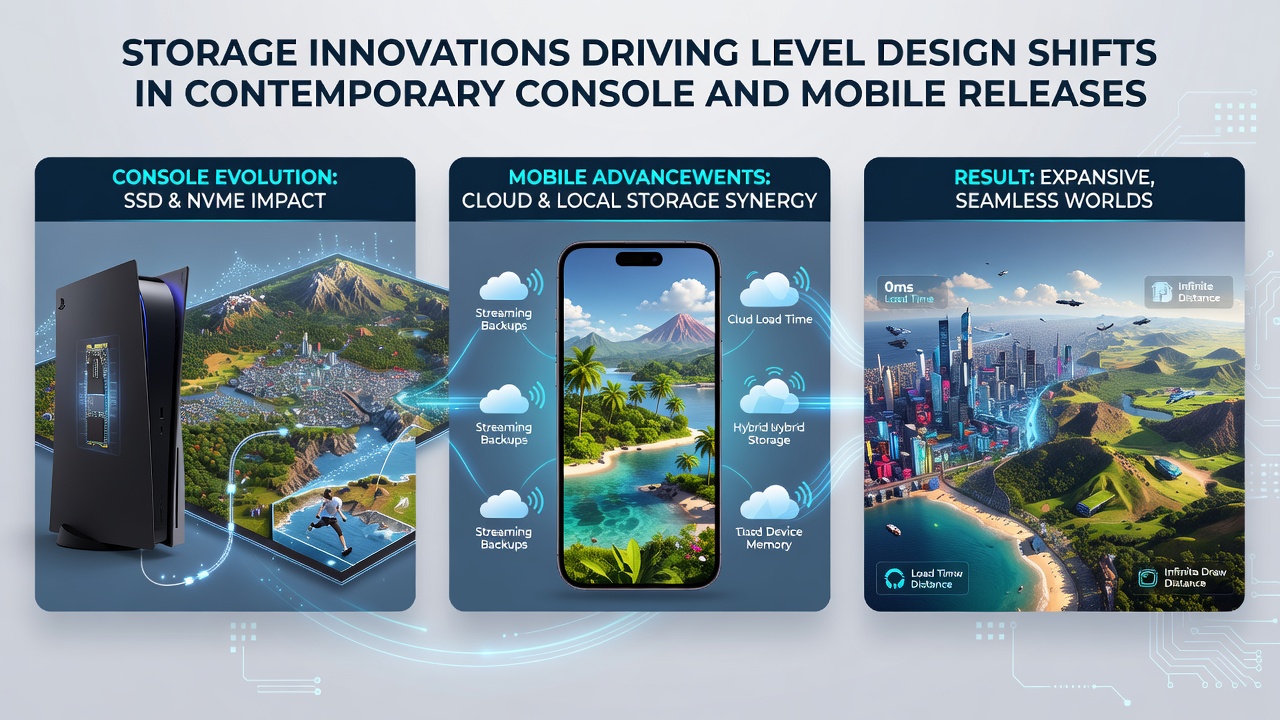
Developers working on cross-platform projects have applied the same streaming techniques seen on consoles to portable releases, creating persistent world states that carry forward when players switch between devices. Academic papers from North American universities highlight how improved random read performance supports procedural elements, such as dynamically generated side paths or resource nodes, without interrupting mobile gameplay loops.
Case Examples Across Platforms
Several releases demonstrate these principles in action, where storage bandwidth directly informs spatial layout choices. Titles leverage instant asset retrieval to implement day-night cycles that alter entire districts on the fly, pulling updated lighting and object states without pausing player control. Industry data compiled by trade associations indicates rising adoption of such techniques in both premium console experiences and scaled-down mobile ports.
Design teams now map out levels around bandwidth budgets rather than solely polygon counts, ensuring that high-detail interiors coexist alongside expansive exteriors through prioritized streaming queues. What's notable is the emergence of hybrid structures where mobile versions retain core connectivity features while adjusting asset resolution to match available storage throughput on various handsets.
Trends Observed in August 2026
Market tracking conducted through August 2026 shows continued refinement of storage-aware tools within major engines, with middleware updates that automate decompression scheduling across console and mobile targets. Reports from international gaming bodies document increased use of cloud-assisted caching layered atop local fast storage, allowing hybrid experiences that maintain consistency when network conditions vary.
Those tracking hardware roadmaps note that upcoming controller revisions emphasize even lower access times for smaller data packets, which aligns with design experiments involving densely populated scenes where multiple characters and interactive objects load concurrently. Evidence from development surveys suggests these capabilities encourage experimentation with non-linear progression systems that branch based on real-time environmental states.
Conclusion
Storage innovations continue to expand the vocabulary available to level designers working on contemporary platforms, shifting emphasis from segmented stages toward integrated, responsive environments that respond to hardware throughput rather than legacy constraints. Continued collaboration between hardware engineers and creative teams sustains this trajectory, with performance metrics guiding spatial decisions across both console and mobile ecosystems.