Texture Streaming Breakthroughs Transform Graphics Capabilities on Budget Mobile Devices
Carlo Peters · Jun 13, 2026

Texture Streaming Breakthroughs Transform Graphics Capabilities on Budget Mobile Devices
Texture streaming has emerged as a core technology in modern game engines, allowing developers to load and unload high-resolution textures dynamically based on player proximity and hardware constraints. Recent advancements in this area have enabled entry-level mobile devices to render visuals that rival those previously reserved for high-end consoles and PCs, with data from industry reports showing measurable gains in frame rates and memory efficiency across multiple device tiers.
Understanding Texture Streaming Mechanics
Developers have long faced limits when packing detailed environments into games for smartphones because of restricted RAM and GPU bandwidth. Texture streaming addresses these issues by prioritizing assets in real time, pulling only the necessary mipmaps into memory while keeping lower-resolution versions ready as fallbacks. According to a 2025 study published by the University of Melbourne's Digital Games Research Centre, optimized streaming algorithms reduced peak memory usage by up to 40 percent in open-world titles tested on mid-range Android hardware.
Engine teams integrate these systems through virtual texturing pipelines that divide large texture atlases into tiles, streaming them over the network or from local storage as the camera moves through scenes. This approach avoids the need to preload entire texture sets at launch, which had previously caused crashes or stuttering on devices with 4GB or less RAM.
Key Technical Advances in 2025-2026
Breakthroughs announced at developer conferences throughout 2025 focused on predictive loading models powered by machine learning. These models analyze player movement patterns to prefetch textures several seconds ahead, cutting visible pop-in during rapid camera shifts. Figures from ARM Holdings' 2026 mobile graphics benchmark reveal that devices using the latest Mali-G series GPUs achieved 60 frames per second in titles with 4K texture assets after implementing these predictive systems.
Hardware support has also improved through tighter integration with mobile SoCs. Qualcomm's Snapdragon 7 series, released in early 2026, includes dedicated texture decompression units that handle adaptive scalable texture compression formats more efficiently than previous generations. The result shows up in sustained performance during extended play sessions, where thermal throttling occurs later than on older chipsets.
Impact on Entry-Level Hardware Accessibility
Entry-level smartphones priced under $300 now support games that once demanded flagship specifications. Data collected by the International Game Developers Association indicates that adoption of advanced streaming techniques increased the number of titles reaching 1080p resolution with 30 frames per second on devices released between 2023 and 2025. This shift expands the addressable market for publishers targeting regions where premium hardware remains less common.
One case study from a Southeast Asian studio demonstrated how their action-adventure title maintained visual fidelity across both flagship and budget devices by relying on runtime texture prioritization. Players on lower-end hardware experienced the same environmental detail as those on higher-spec phones, although draw distances adjusted automatically to stay within memory budgets.
Industry Adoption and Case Examples
Major engine providers have rolled out updated tools that simplify implementation for smaller teams. Unity and Unreal Engine both released texture streaming modules in mid-2025 that include automated mip selection and background loading threads. These updates lowered the technical barrier for independent developers working on cross-platform projects that include mobile targets.
By June 2026, several high-profile releases had incorporated these features, resulting in broader distribution on app stores without requiring separate low-graphics versions. Reports from the European Games Developer Federation note that development time for mobile optimization dropped by an average of three weeks per project when teams used the new streaming frameworks from the start.
Future Outlook Through Mid-2026
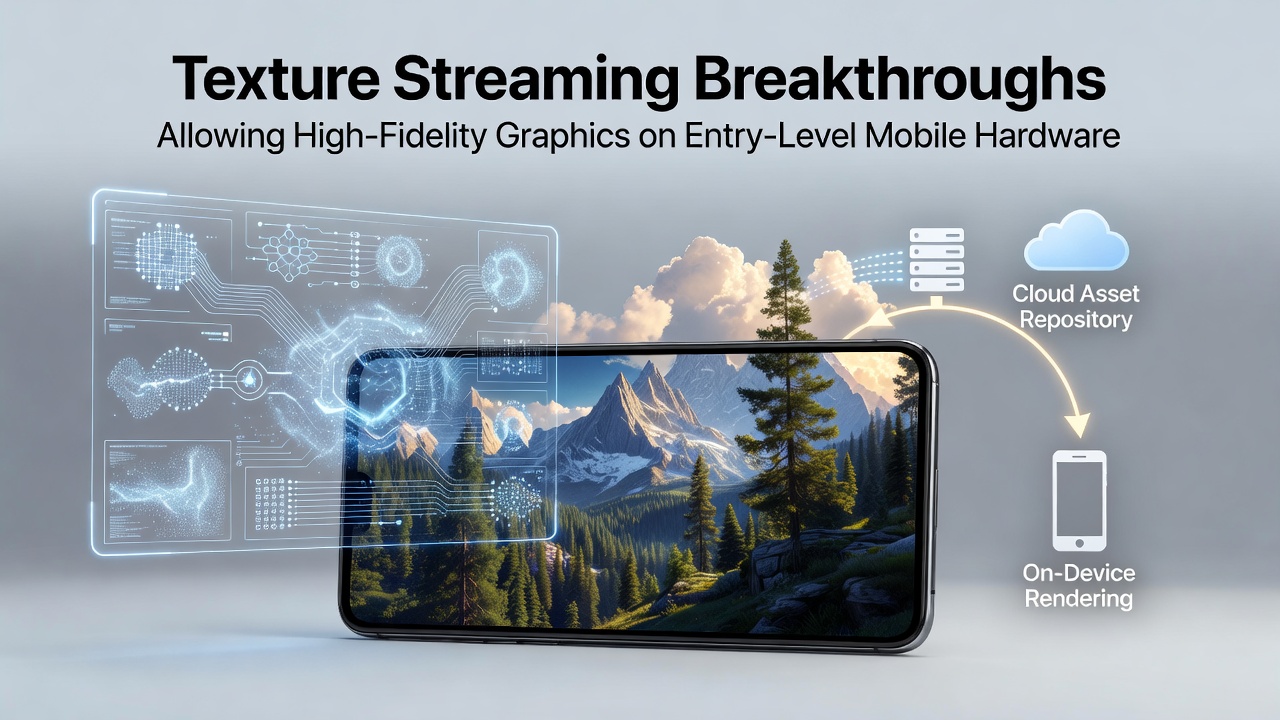
Continued refinement of compression algorithms and cloud-assisted streaming promises further gains. Research groups at institutions such as the National University of Singapore are exploring hybrid approaches that combine on-device prediction with selective cloud texture delivery for particularly large assets. Early tests show potential reductions in local storage requirements while preserving image quality during online play.
Device manufacturers continue to align hardware roadmaps with these software advances, focusing on increased unified memory pools and faster storage interfaces. The combination supports the trend toward unified game versions that scale gracefully from entry-level phones to premium tablets and handhelds.
Conclusion
Texture streaming breakthroughs have shifted the landscape for mobile graphics by decoupling visual fidelity from raw hardware specifications. Data across multiple sources confirms that entry-level devices now deliver experiences once limited to more expensive platforms, driven by algorithmic improvements and hardware co-design. As these techniques mature through 2026 and beyond, the gap between device classes continues to narrow in measurable ways.